A sloop is a versatile and historically significant maritime vessel characterised by its single mast and fore-and-aft rigging. The term “sloop” has evolved, but traditionally, it features a single mast, carrying a main sail and a jib.
The design’s simplicity and efficiency made sloops popular for various purposes, from fishing and coastal trading, and naval service. Over time, the term “sloop” has broadened to include various sailboat designs, often differentiated by the number and arrangement of sails.
Royal Naval Sloops date back centuries. They evolved from small, single-masted vessels to become specialised warships. In the 18th and 19th centuries, Royal Navy sloops served as dispatch vessels, patrol craft, and reconnaissance ships. They played key roles in conflicts such as the Napoleonic Wars. In the 20th century, the Royal Navy introduced several notable Classes of sloop.
In World War I, ships in the Flower Class were armed convoy escorts. In 1922, HMS SAXIFRAGE was moored on the Thames and renamed PRESIDENT. In early 1938, HMS CHRYSANTHEMUM was moored nearby. Both vessels were used as Royal Naval Reserve training ships throughout WW II and afterwards, until both were sold in the 1980s, at which time HMS PRESIDENT went ashore to St Katharine Docks.
The final class of Royal Naval sloop to be built, from 1938 onwards, was the Black Swan Class (and modified Black Swan Class). The term sloop was dropped by The Admiralty during the Second World War.
The historical significance of Royal Naval sloops was in their adaptability and their major contribution to the protection of seaborne trade in their convoy escort role, through their anti-submarine and minesweeping/minelaying, and their anti-aircraft capabilities
The Royal Navy Grimsby Class Sloops were planned and constructed during the interwar period and were designed with versatility in mind, embodying a balance of armament that allowed them to perform multiple roles, to counter the evolving threats posed by submarine and mine warfare. They were an essential part of the Royal Navy’s wartime fleet, notably during the Battle of the Atlantic.
HMS WELLINGTON was the fourth in Class to be built. Following four years in her peacetime role as a patrol ship in the SW Pacific, she had a distinguished service record escorting convoys during the critical Battle of the Atlantic, and in West Africa convoys, undertaking 103 patrols and covering 250,000 nautical miles. She remains the last in Class and has World Historic Ship status.
The development and construction of the Grimsby Class Sloops were in response to the increasing menace of submarines between 1918 and 1939. The lead ship, HMS GRIMSBY, was built and launched in Devonport dockyard in 1933, paving the way for a total of thirteen ships.
HM Naval Base Devonport
Grimsby Class Sloop, 4th in class of 8 RN (plus 4 for RAN) Pennant Number L65, U65
29th May 1934
24th January 1935
1379 tons DWT
Length: 266 ft Beam: 36ft Draught: 9ft
Three
Two shafts, geared turbines, 2,000 SHP
16.5 knots (max), maximum endurance: 6000 nautical miles at 10 kts with 337 tons of oil fuel
2 x 4.7-inch single low angle guns.
1 x 3-inch high-angle gun.
3 x pdr saluting guns.
Hedgehog replaced three high-angle guns (mid 1942).
Type 271 radar (on bridge), replaced by Type 282, and HF/DF fitted (on after mast) in 1942.
Quad 0.5” anti-aircraft machine guns fitted port and starboard, later replaced with 22mm Oerlikons, and later with 40mm Bofors.
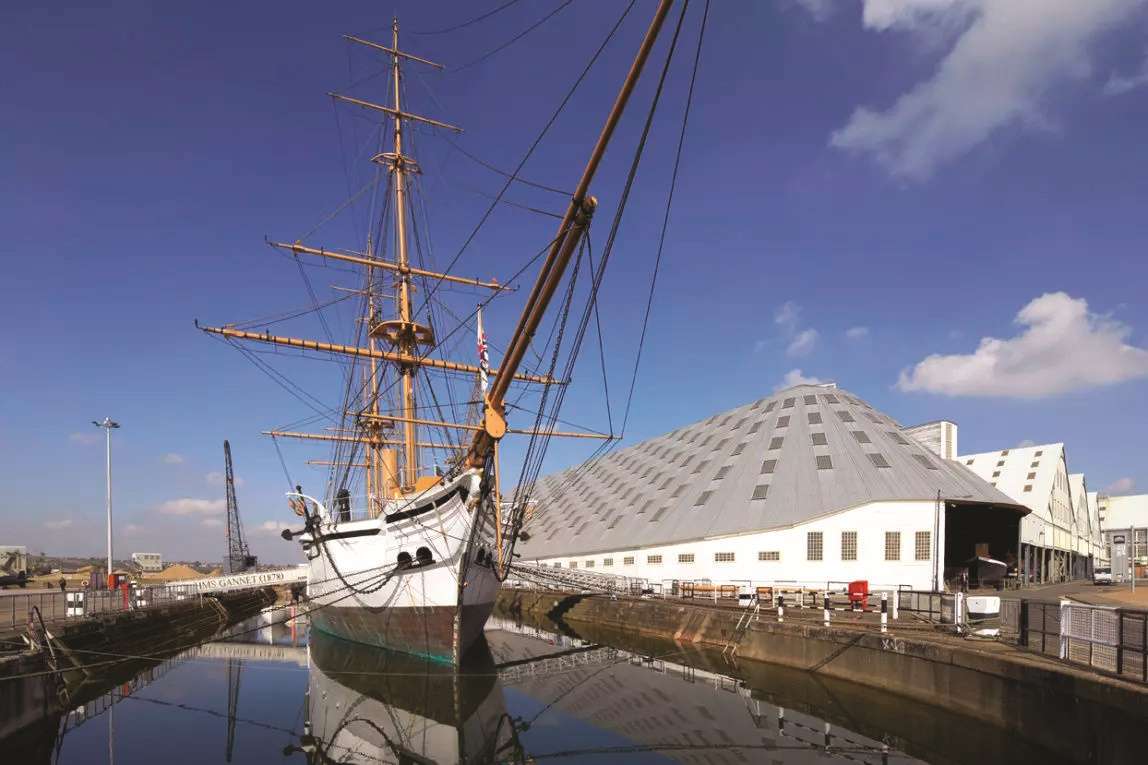
HMS GANNET, launched in 1878, is the last known example of a Royal Naval Doterel Class sloop of war and
is now preserved in Chatham Historic Dockyard.